Article contents
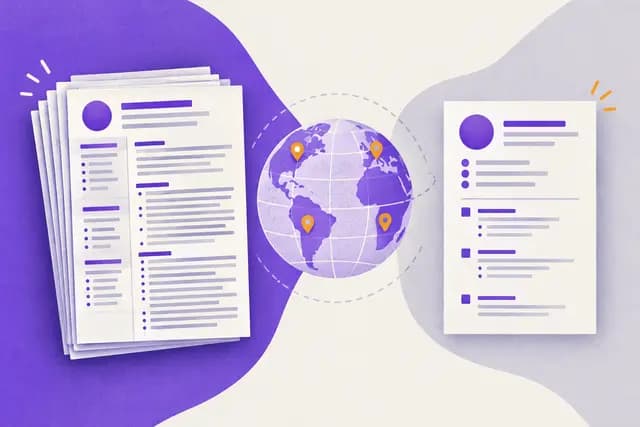
Many CV templates come with a neat little square waiting for a headshot. Whether a photo on a CV is a good idea is a surprisingly regional question: what looks entirely normal in one country can look odd, or even like a risk, in another.
So the useful question isn't "is it allowed?" but "does it help me, here, for this role?" If you're applying in the UK, Ireland, Canada, the US or Australia, the answer is usually no.
Photo on a CV: expected, optional or discouraged?
In most English-speaking job markets, a photo is not expected. Employers there generally prefer to assess you on skills and experience, and many try to keep appearance out of the early stages of hiring. A CV with a photo won't necessarily be rejected, but it can look unfamiliar, and some recruiters may find it unhelpful.
A photo proves nothing about your ability. It also takes up space that could carry another line of achievement, and it shares details (apparent age, background, appearance) that have no bearing on whether you can do the job.
A sensible default:
- No photo if you're applying to employers in the UK, Ireland, North America or Australia, or to large organisations that run standardised recruiting.
- A photo only if local convention in your target market and sector still expects one, or if the employer asks for it explicitly.
It is never your obligation to provide one unless a specific application demands it, and even then you can decide whether that's a process you want to take part in.
What conventions look like by country
Habits differ by country, sector and even company size, and they keep changing. Take the table below as a general picture, not a rule.
| Context | Typical practice |
|---|---|
| UK and Ireland | Generally not included. Recruiters often prefer no photo. |
| United States | Generally not included; many employers prefer not to receive one. |
| Canada | Generally not included, though practice can vary by employer, including in Quebec. |
| Australia and New Zealand | Usually not included. |
| France, Belgium | Optional. Still seen, but increasingly omitted. |
| Germany, Austria, Switzerland | Long common on traditional CVs, now declining, though still seen in some sectors. |
| Spain, Italy | Often included, but not universal. |
The very idea of a "CV" differs from place to place: in North America you'd usually write a resume, with its own norms. Our guide to CV or resume and the differences between countries covers that in more detail.
A simple rule: look at how professionals in your sector present themselves in the country you're targeting, and follow that. When unsure, leave it out.
Photo, ATS and layout
Many employers use an applicant tracking system (ATS) to receive and sort CVs. These tools read text. An image isn't information for them, but it can create indirect trouble:
- Column layouts. To make room for a photo, many templates use a side column. Some systems read those blocks in the wrong order and scramble your details. Our piece on ATS myths and facts explains what really matters.
- File size. A high-resolution photo can bloat a PDF past the limit of an upload form.
- Text inside images. If your contact details or skills are part of an image next to the photo, they may not be read at all.
A well-placed photo in a clean PDF won't, by itself, break an ATS. The risk lies in the structure around it. If you include one, keep your text as real text, in a simple reading order.
The space it takes
On a one-page CV every centimetre counts. A headshot and its frame can easily cost you two lines of experience. If your CV is spilling onto a second page, the photo is the first thing to question. For where to draw the line, see how long a CV should be.
Privacy and bias: the trade-offs
A photo reveals things you may not have chosen to share: perceived age, gender, background, apparent health, style. A fair-minded recruiter tries to set these aside, but nobody is fully immune to first impressions.
That is why many organisations, and some recruiting processes, remove or hide photos before reading applications. For you it cuts both ways:
- A photo can help if it gives a positive impression consistent with the role.
- It can also count against you, without your knowing and without any chance to respond.
Then there is where your CV ends up. It may be forwarded, stored in databases, copied between systems or archived. Your face travels with your name, phone number and address. Think twice before sending the same version to fifty employers or uploading it to just any platform.
On the legal side, rules differ by country and by employer, and this isn't the place to list them. What matters in practice: in most contexts you're not required to provide a photo, and you can leave it out without explaining why.
Choosing a photo if you do include one
Where a photo suits the context, prepare it with the care you'd give your opening summary.
What works
- Tight framing: head and shoulders, face clearly visible, looking at the camera.
- A plain background: a neutral wall or a softly blurred outdoor setting.
- Natural light: facing a window rather than using flash or shooting into backlight.
- Clothing suited to the sector: what you'd wear to an interview for this role.
- A natural expression: a relaxed, slight smile, not a stiff pose.
- A recent picture: it should look like you today.
What to avoid
- Selfies, holiday shots or crops from a night out.
- Sunglasses, hats, filters or novelty backgrounds.
- Group photos, even with other people cropped out.
- Pixelated, stretched or artistic black-and-white images.
- A photo from ten years ago that creates a surprise on interview day.
Technically, use a square or slightly vertical crop at a reasonable resolution, so the PDF stays light, and keep the same photo across your professional profiles, including online ones.
A good test: show it to someone you trust and ask, "If you were hiring for this role, what does this picture say to you?" If the answer is anything other than "a capable, approachable person", retake it.
Example: the top of a CV, with and without a photo
Here is a header with no photo, built around the essentials:
Jordan Hughes Digital Marketing Executive · Manchester jordan.hughes@example.com · 07700 900000 · linkedin.com/in/jordan-hughes
Marketing executive with five years in agency roles: content strategy, paid social and reporting. Looking to join an in-house product marketing team.
With a photo, the image takes up the left column and pushes the summary and the start of your experience lower down. If your CV already fits on a page by a whisker, that's the trade-off to weigh.
Now a before/after bullet that makes better use of the space a photo would have taken:
- Before: "Managed the company's social media accounts"
- After: "Ran four social accounts; grew average engagement by 18% in six months with a new content calendar"
That line tells a recruiter something concrete about your work. A face can't. For more on this, see how to show your experience with quantified results.
Checklist before you send
- Does the country and sector expect a photo, or is it discouraged?
- Does the posting or application form explicitly ask for one?
- Does my CV still hit the length I want with the photo in?
- Is my text real text, in a simple reading order, with nothing key hidden in an image?
- Is the file a reasonable size?
- Is the photo recent, sharp, neutral and consistent with my online profile?
- Do I have one version with and one without, to send as appropriate?
Keep two versions of your CV so you don't have to patch things up for each application. A well-built template lets you add or remove a photo without breaking the layout; you can browse our CV templates to find one that handles both.
Common mistakes
- Adding a photo on autopilot, without asking whether it serves the application.
- Sending the same version abroad. A CV for the US or UK is built differently from one for continental Europe.
- Ignoring quality. A poor photo does more harm than none.
- Sacrificing content. Trimming your experience to keep a photo is almost always a bad trade.
- Being inconsistent. One photo on the CV, a very different one on LinkedIn.
Your photo online matters too: see how to keep your CV and LinkedIn profile consistent.
Frequently asked questions
Should I put a photo on my CV in the UK or US?
Generally no. Employers in these markets usually don't expect one, and many prefer not to receive it. Spend that space on your achievements instead.
What if I'm applying in a country where photos are common?
Check local conventions for your sector, since they differ within countries. If you decide to include one, make it professional and recent, and keep a no-photo version for other applications.
Can a photo affect how an ATS reads my CV?
Not directly, but the layout around it can: columns, text embedded in images or a heavy file may cause problems. A simple structure and a light PDF avoid most of them.
Will a photo help me get more interviews?
Nothing guarantees that. It can make a good impression, but it can also trigger unintentional judgements. Clearly presented achievements are what make the difference.